It is said that behind every circumstance in life, even the most painful, there is always something to learn. History shows how, over the centuries, there have been periods of uncertainty due to majeure events, but after each difficulty, complicated and seemingly impossible to overcome, we came out stronger than before.
Going back to 1918-19, the world population was hit by the so-called Spanish flu, considered one of the most important historical events of the last centuries: it broke out just before the Great War, at a time when the population was completely overwhelmed, both psychologically and economically. came to count some 50 million deaths. At the time, the restrictive measures adopted were the same we are experiencing today: commercial activities, schools, theatres and churches were closed, quarantine was compulsory for positive and suspected cases, and gatherings were banned.
In addition to the Spanish flu, there was also the Asian influence of 1957 and the Hong Kong influence of 1968-69. All these events have one fundamental common, which is the subsequent economic boom. In this respect, an encouraging study (2020) by three well-known American economists – Sergio Correia, Stephan Luck and Emil Verner – shows that in the days of Spanish flu, all those cities that implemented strict and aggressive containment measures did not suffer major falls in economic activity, but only a temporary reduction in turnover. In fact, the measures implemented were necessary to reduce the mortality rate and avoid economic collapse, and even led to economic growth and higher wages in the United States in the 1920s. They entered a phase of optimism and euphoria, based on the philosophy of carpe diem.
How do we explain this rapid recovery following such a deep crisis?
In a recent interview, Leopoldo Gasbarro – director of the magazine Wall street Italia and of the web finance channels of Gruppo Triboo Spa – answered this question with the following statement, referring to last summer: “After spending three months indoors, we witnessed a fast filling of tourist facilities. People wanted to go out, find themselves and go a little further than they would have done in a normal situation”.
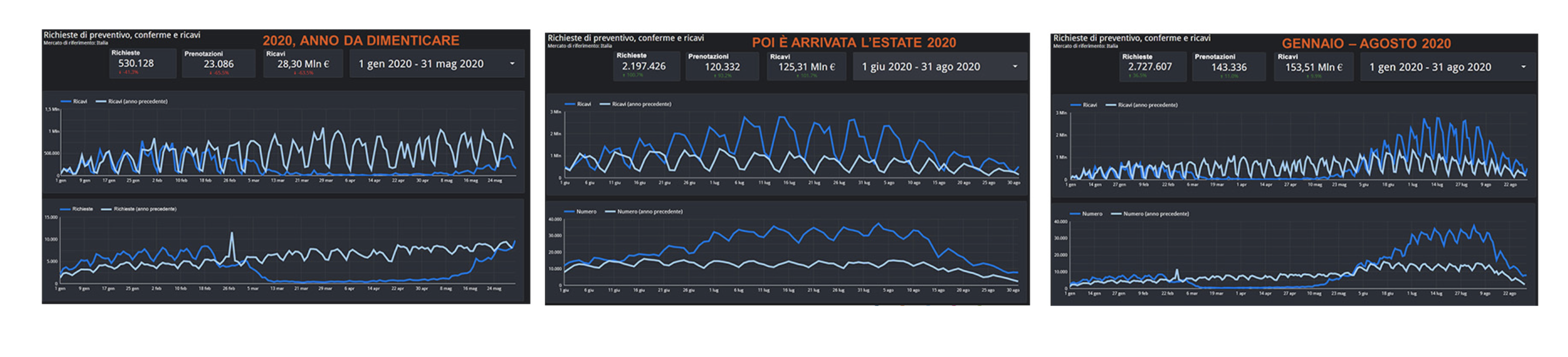
Looking at the following graph, based on a sample of 650 Italian facilities, it emerges that there was a surge in demand during the summer months.
Source: https://news.titanka.com/2020/10/29/hotel-e-camping-village-ripartire-dopo-la-pandemia/
Compared to the previous year (light blue line), the first two months of 2020 (blue line) saw a significant increase in turnover, which dropped to zero in the lockdown months, only to experience a subsequent explosion during the summer. In the latter phase we found ourselves with an unexpected volume of enquiries, well above 2019.
This happens because, despite the restrictions, the desire to travel is still alive, and it is from this awareness that we should start taking into account how restrictive measures have led to a profound change in the behavior of tourists, both in the short and long term. In both present and future time, travelers want to travel safely, they want flexible cancellation conditions, they prefer open-air locations, but they also prefer local travel, because it is easier and safer to get around.
Research by Booking.com on a sample of 20,000 people in 28 countries revealed some important data:
- 95% of respondents used their free time during the lockdown to seek inspiration for future travel.
- 74% said they wanted more transparency on cancellation and refund conditions.
- 65% said they would like to travel as frequently as before, both domestically and internationally.
- 51% will be more inclined to visit off-peak destinations, also to avoid overcrowding
- 46% want to discover their own country
These data, seen through the eyes of a tourism operator, are really valuable. To get going again, we need to shift our focus from problems to possible solutions. Let’s identify with the figure of the phoenix, which rises from her own ashes after death and, for this very reason, symbolizes the power of resilience, i.e. the ability to cope positively with adversity by cultivating the resources within ourselves.
Therefore, what we can do today to face the uncertain future that awaits us, is to live this moment as an opportunity to re-enter the market with a new impetus. In this last period, in which the restaurant industry was once again brought to its knees with the closure of bars and restaurants at 6 p.m., the situation has been reversed: those who want to dine out without having a curfew can only do so by staying in hotels. In this new scenario, at least hoteliers will be able to take this opportunity and make the most of it, and there are those who have already done so ironically.
One example is the hotel-restaurant Zunica 1880 in Civitella del Tronto, one of Italy’s most beautiful villages in the Gran Sasso National Park, which attracts its customers with the following proposal on social media: “eat, drink and then make love in your room at a ridiculously low price: 190 euros for two”.
Today is the right opportunity to unleash creativity. It is essential to spend your time and energy working on communication and people, bearing in mind that the tourism industry is constantly evolving, as are the needs of travellers and the technologies that support our activities. Once you have identified where you need to improve, it will be easy to grow your business in the future and have a positive impact on your customers. This is a unique opportunity and should not be wasted!
I would like to end with a quote that seems to perfectly fit with the situation we are living in:
“There has never been a better time to be exceptional than this, and there has never been a worse time to be average.”
(Scott Galloway)
Francesca Capece
Content editor
Hospite – The Italian Hospitality Academy