
Today, at the gates of 2025, there are multiple training tools, methodologies and possibilities to support talents in their professional and personal growth process. This is because, thanks also to the increased awareness of how crucial it is to guide people and employees along their career path, methods have emerged that, until a few years or decades ago, were hardly ever considered.
Training nowadays: what are the innovative methods in the world of luxury?
I imagine that if I said to you ‘today we are doing 5 hours of training’, you could easily think of classic classroom training, where one or more trainers take turns sharing theoretical concepts to a more or less numerous audience that learns the concepts in a passive mode, i.e. receiving concepts and explanations and then absorbing them.
Assuming that this methodology is fundamental if we want to provide the staff of a hotel or other company in the luxury world with valuable technical and theoretical tools, we believe that being able to alternately use this method considered ‘classic’ is extremely important.
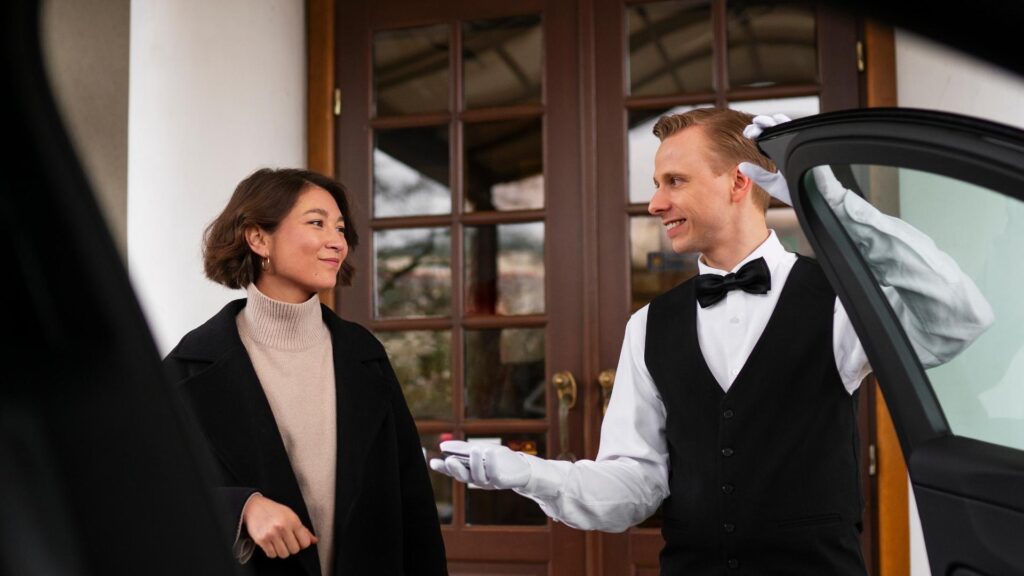
So what are the two methodologies that we consider to be fundamental?
Experiential training
Experiential training is a teaching approach based on learning through direct, first-hand experience. This method goes beyond the simple transmission of theoretical knowledge by involving training participants in hotels and/or companies in practical activities that simulate real situations (what we call ‘role play’).
The central idea is that people learn best when they are actively involved in the learning process and can reflect the concepts learned on their own experiences in their working environment (at the Front Office, in the Food & Beverage department, etc.). This type of training is often used to develop practical and soft skills such as leadership, communication and teamwork.
The origins of experiential education can be traced back to theorists such as John Dewey, Kurt Lewin and David Kolb. Dewey claimed that education must be based on experience, while Lewin introduced the concept of the ‘experiential learning cycle’. Kolb developed a model that describes learning as a cycle of four phases: concrete experience, reflective observation, abstract conceptualisation and active experimentation.
In concrete terms, when we implement this type of methodology, in addition to role plays and simulations, we also draw on very different worlds, such as theatre.
Coaching On the Job
Coaching On the Job is a training method in which an expert coach supports employees directly in the workplace. This approach aims to improve professional and behavioural skills through immediate and personalised feedback. In the context of luxury hospitality, the aim is to coach staff so that they can improve their approach to the guest in real time, thanks to the feedback that the professional shares directly.
This type of coaching not only helps employees improve their technical skills, but above all promotes the development of soft skills such as communication, leadership, problem solving and complaint handling.

What are the benefits of Experiential Training and Coaching On the Job?
Now that we have looked together at the characteristics of these two training methods in the world of the luxury hotel industry, we can explore the 3 main benefits:
- Employee engagement: these two training methods ensure that employees can be personally involved and challenged in a practical way by the coach and/or trainer
- Individual focus: thanks to simulations, role plays and direct feedback during coaching on the job, professionals receive the trainer’s full attention and share individual feedback on the work done and/or the role play just performed
- Quick implementation of feedback: thanks to direct experience in training or during coaching on the job, employees have the opportunity to implement the feedback received in real time (in the case of coaching), and (in the case of experiential training) they have the opportunity to ask for further feedback from the professional trainers by carrying out new role play activities.
Experiential training and on-the-job coaching are essential approaches for the luxury hospitality sector, as they offer a unique opportunity for hands-on learning, closely contextualised to the specific needs of an ever-changing industry.
In the world of hospitality and luxury, where excellence lies above all in the quality of human relations, the continuous enhancement of one’s skills becomes the engine that fuels customer satisfaction, the beating heart of the success of every service offered.
Investing in these approaches means not only training professionals, but inspiring people who, day by day, contribute to creating experiences that remain in the hearts of customers, making each interaction a masterpiece.
Martina Dalla Vedova
Marketing Manager Hospite S.r.l.